The Risks of the New World Screwworm
How the Pest Affects Animals and What Horse Owners Can Do
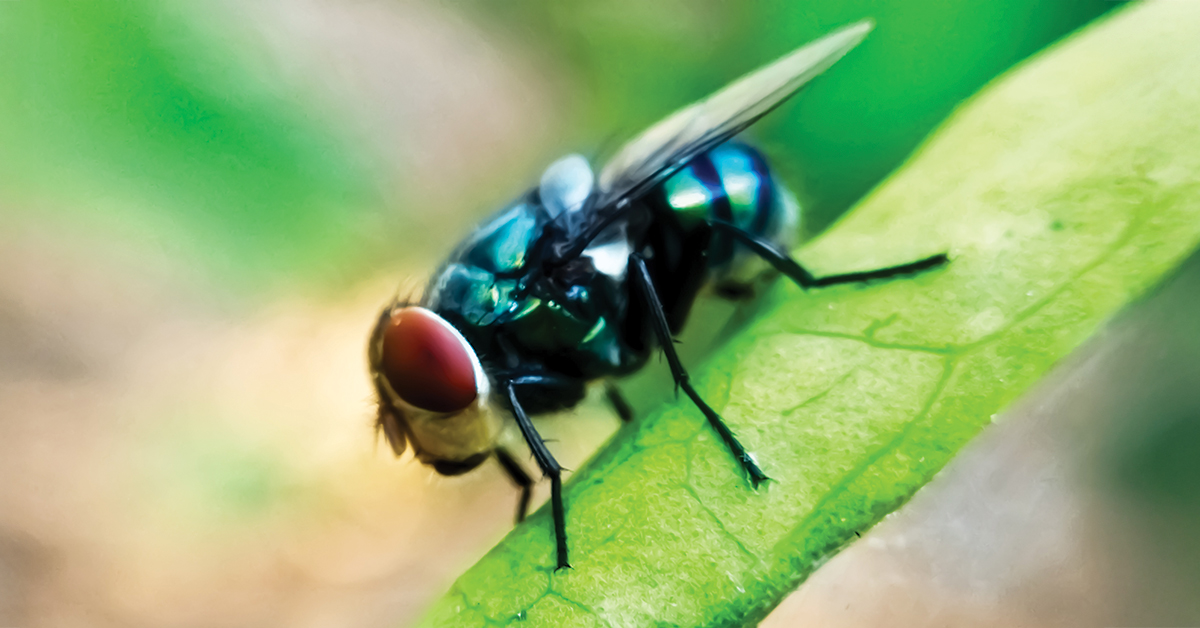
ISTOCKPHOTO.COM
Contributing Veterinarians

Christine Navarre,
DVM, MS, DACVIM
Louisiana State University

Jennifer Koziol,
DVM, MS, DACT
Texas Tech University

Rosslyn Biggs,
DVM, DACVIM
Oklahoma State University
Quick Answer
What is the New World screwworm, and how can it affect horses?
The New World screwworm is a fly whose larvae feed on living tissue. Female flies lay eggs in wounds, including very small wounds, and the larvae can cause painful, foul-smelling injuries. Horses and other warm-blooded animals may be affected. Inspect animals regularly, discuss wound care and travel plans with your veterinarian, and seek veterinary care promptly if you suspect an infestation.
In this article you'll learn:
- ✓How New World screwworm larvae affect animals
- ✓Which animals and wounds are at risk
- ✓How sterile flies help control the pest
- ✓What horse owners should consider before travel
- ✓Why veterinary guidance matters for treatment
What is the New World Screwworm?
The threat of the New World screwworm fly (Cochliomyia hominivorax) loomed just south of the Mexican border in recent years, poised to cross into Texas and New Mexico where its impact could create significant concern for the large cattle herds and other livestock operations that call the region home.
This pest lays 200–300 eggs at a time in open wounds and natural orifices on warm-blooded hosts, including cattle, sheep, goats, companion animals, horses and even humans. Resulting larvae form within 12–24 hours, forging a damaging trail on the host, beginning in the open wound and, using their distinctive mouth hooks, burrowing their way deep into surrounding flesh in a screw-like fashion, causing strong, foul-smelling wounds along with pain, tissue death and infection.
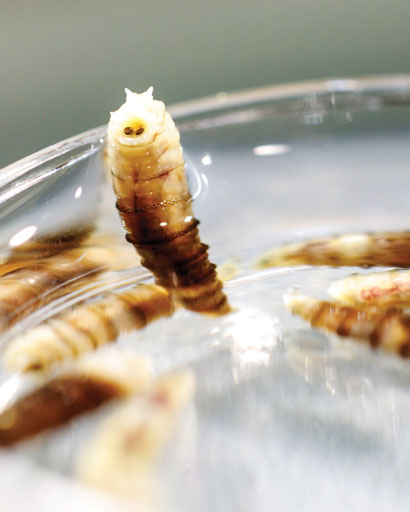
New World screwworm larvae use distinctive mouth hooks to burrow into surrounding flesh.
PHOTO BY MITCH ALCALA/OSU AGRICULTURE
If left untreated, the host animal can die as a result. These destructive larvae mature within 5–7 days, then drop to the ground to pupate in the soil, where the lifecycle begins anew.
Prior to June 2026, the New World screwworm fly (NWS) had been eradicated on U.S. soil in 1966, with only two isolated incidences of the pest being detected: one in Texas in the 1970s and the other in the Florida Keys in September of 2016.
After years of monitoring and careful planning for the inevitable, the U.S. Department of Agriculture, under the leadership of USDA Secretary Brooke Rollins, confirmed an active outbreak with cases detected in the border states of Texas and New Mexico.
As of August 2026, there had been 45 confirmed cases (5 active, 40 inactive) in cattle, sheep, goats and one dog but no reported cases in humans or the equine population within the United States. In contrast to low active case numbers within the U.S., Mexico and Central American countries have reported nearly 200,000 NWS cases in animals and nearly 2,500 cases in people.
New World Screwworm: Life Cycle
- Egg Stage: Females lay 200–300 eggs in open wounds and natural orifices on warm-blooded hosts.
- Larvae Stage: Larvae form within 12–24 hours and burrow their way deep into surrounding flesh, causing foul-smelling wounds. These destructive larvae mature within 5–7 days.
- Pupate Stage: Mature larvae leave the wound, then drop to the ground to pupate in the soil.
- Adult Stage: Adult flies emerge from the pupa in 7–54 days, depending on temperature and humidity. Adults are sexually mature in 3–5 days.
New World Screwworm Larvae
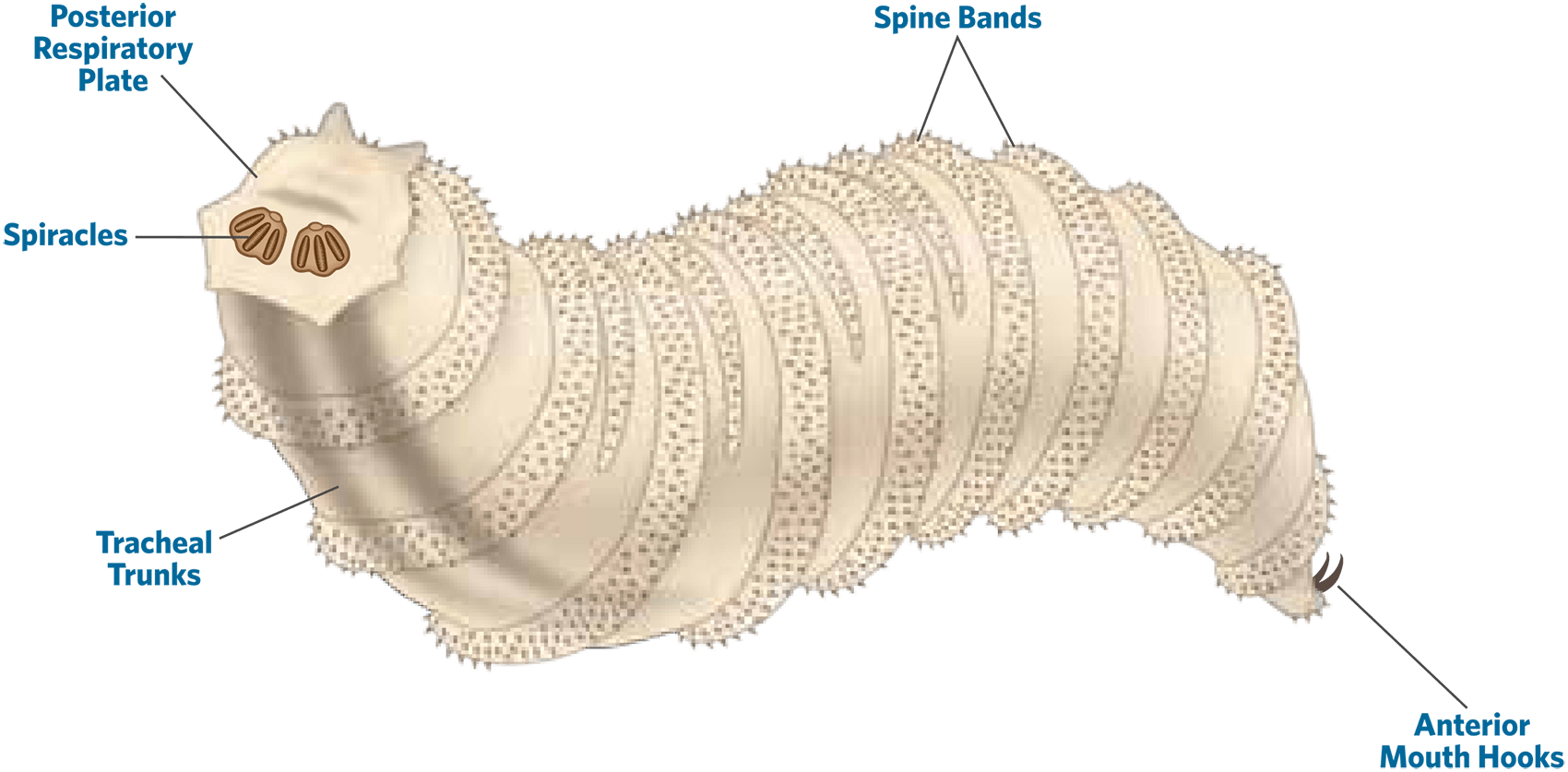
©2026 PLATINUM PERFORMANCE, INC./TOPLINE DESIGN
How New World Screwworm Reached the U.S.
While risk from the infestation remains low in people, vigilance is encouraged in the equine population as ranchers take steps to curb the threat through close monitoring and treatment protocols for their livestock.
Becoming informed and educated on the preventive strategies and available action steps for NWS is crucial for anyone with animals but especially livestock and horses. “It was around 2004 when we started to recognize the NWS was creeping closer to the U.S. border,” explains Dr. Jennifer Koziol, a veterinarian, board-certified theriogenologist (reproduction) and an associate professor of food animal medicine and surgery at Texas Tech University’s School of Veterinary Medicine in Amarillo. She also serves as a member of the Beef Reproduction Task Force, a multidisciplinary group formed by research and extension faculty members from universities across the nation with a focus on beef cattle reproduction, management and reproductive technologies. “In late 2024, it began moving up Mexico, and that’s when concern started to grow.”
As the pest moved northward, the U.S. government closed the southern border to all ruminants in the hopes that with Mexican cattle being barred from entry, the U.S. could buy additional time. “Even with the border closed to cattle entry, we’ve watched the pest continue to come up through Mexico until June of 2026 when it finally crossed over and cases were detected on U.S. soil,” Dr. Koziol details.
After its elongated closure, the USDA’s Animal and Plant Health Inspection Service (APHIS) set plans in motion to reopen the border between the Douglas, Arizona, port and the Mexican State of Sonora to livestock trade on August 24, 2026. APHIS will evaluate the success of this limited border reopening, conducting a risk assessment that will determine whether subsequent border ports of Santa Teresa, New Mexico, and Columbus, New Mexico, will then reopen to cattle, bison and horses. The plan for border reopening will remain fluid and depend on “Mexico’s progress in meeting Action Plan milestones and addressing critical issues,” according to APHIS’s website. Open ports will continue to be evaluated, and further plans may be paused if increased risk is recognized at any point.
Which Animals Are at Risk?
Both old and young animals are at risk from the NWS since the pest — unlike other parasitic blowflies — uniquely targets live tissue. In the case of NWS, the concern isn’t the spread of a disease. Rather, a female fly lays her eggs on living tissue. “That's what she loves most is a fresh, open wound,” cautions Dr. Koziol. “The wound can be very small; something as small as a tick bite is big enough for the fly to then lay her eggs and fly away.” The fly itself is rarely spotted; it’s the larvae that are of primary concern. “The larvae will eat that tissue,” continues Dr. Koziol. “That’s where our problems lie. This is a concern for any animal with an open wound since the decay can spread and attract maggots deep inside the wound.”
“The wound can be very small; something as small as a tick bite is big enough for the fly to then lay her eggs and fly away.”Veterinarian's Perspective
— Jennifer Koziol, DVM, MS, DACT
Associate Professor, Food Animal Medicine and Surgery at Texas Tech University, Amarillo

The cattle industry has been particularly concerned about the threat of NWS. “While we’ve been focused heavily on cattle, this fly will infest any warm-blooded animal,” says Dr. Rosslyn Biggs, a former Assistant Area Veterinarian in Charge (AVIC), employed by APHIS to manage animal health programs, disease control and veterinary accreditation in Florida, and currently an associate professor of veterinary clinical sciences at Oklahoma State University, Stillwater, where she’s also a beef cattle extension specialist. “And although the human risk is very small, it is present, so vigilance is important across species.”
It remains true that livestock pose the greatest risk for NWS infestation and, up to this point, there have been no reported NWS cases in horses.* “When it comes to our livestock species, we’re concerned about anything with an open wound and that includes our newborns in particular,” she explains. “Luckily, not many calves are being born in hot, fly-prone weather, but we’re concerned about those newborns because we essentially have an open wound at the navel. The NWS fly will lay her eggs there since developing larvae want to eat fresh tissue, not decaying tissue. If left untreated, we can see deaths in animals.”
Economically and from an animal-welfare perspective, concern is high. Rollins, U.S. and Texas agriculture officials, and cattle industry leaders have been sounding public alarms about the fly’s movement across Mexico for more than a year, spurred on by memories of it causing tens of millions of dollars of annual losses — potentially billions in today’s dollars — before its eradication.
From a practicality standpoint, the ability of ranchers to have eyes on every animal within a large herd every day can be limited, forcing them to change their monitoring practices and oftentimes incur increased labor costs along with veterinary expenses if the NWS is detected.
* As of September 2026, there have now been confirmed NWS cases in horses in the United States.
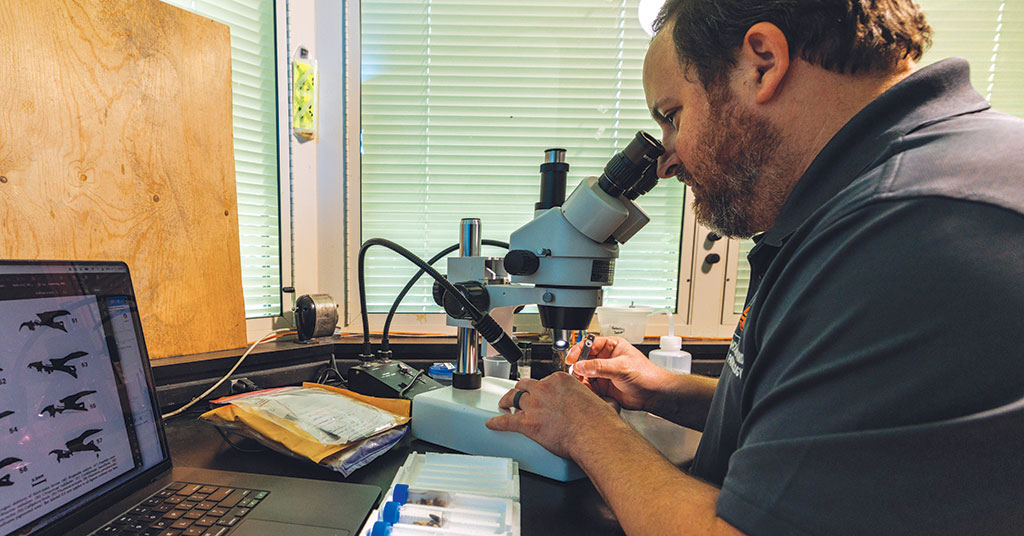
Epidemiologist Dr. Jonathan Cammack is studying a submitted sample under the microscope. Identification should be done by those that have the expertise and not the general public because there are blowflies in the United States that are incredibly similar.
PHOTO BY MITCH ALCALA/OSU AGRICULTURE
How is New World Screwworm Being Controlled?
When the northward path of the NWS was detected in Mexico, the USDA established a five-pronged plan to fight the pest: stop the pest in Mexico before it crossed into the U.S.; protect the U.S. border; maximize readiness; manage infestations; and innovate eradications. “The main way that we control and then eradicate NWS, pushing it back across the southern border, is through a sterile fly technique,” says Dr. Christine Navarre, an adjunct professor at the School of Veterinary Medicine at Louisiana State University, Baton Rouge, and a large animal veterinarian board certified in veterinary internal medicine. She’s also an extension veterinarian at the LSU AgCenter.
“The unique thing about this fly is that the female will mate once, and then she can lay several egg packets. If we release sterile male flies and she mates with a sterile male, she’s going to lay eggs that are sterile, disrupting the lifecycle of NWS.”Science Explained
— Christine Navarre, DVM, MS, DACVIM
Adjunct Professor, LSU Department of Veterinary Clinical Sciences; Extension Veterinarian, LSU AgCenter; and Professor, LSU School of Animal Science

The method has been very successful, with the problem being the lack in adequate sterile fly numbers required to not just fight NWS but to eradicate it within the U.S. “Even though we're flying all the flies that we have, we just don't have enough to keep NWS from migrating north,” Dr. Navarre continues. “That’s where the efforts of the USDA are primarily focused right now: on increasing sterile fly production.”
A second facility for sterile fly production has recently come online in Mexico, in addition to the primary production facility in Panama, with a third facility in development in south Texas, projected to launch in 2027–28. With the second and third facilities, officials are hoping to increase the 100 million sterile flies currently being released weekly, to a much more effective 500 million sterile flies each week, finally giving the strength in numbers necessary for eradication.
In addition, certain movement restrictions have been placed on both livestock and horses coming from infested regions. “When a case gets diagnosed, that area becomes an infested zone where there’s heightened risk,” she explains. “While movements out of the area by livestock and horses aren’t necessarily stopped, there can be controls put in place.”
Ranchers and horse haulers may experience inspections in movement-controlled areas, with increased travel time as a result. “Movement controls are good to be aware of, and to plan ahead for,” she cautions. “If you’re attending a horse show in one of those areas, you really need to get with your veterinarian and get your papers ahead of time. Make plans that account for the extra steps you may need to take when you travel home from those zones because we don't know definitively where NWS is going to pop up next. Be ready and prepared in case NWS is detected where you’re traveling. You may end up stuck for a few days.”
Having extra feed and any regularly needed medication on hand is a good plan in general but especially now that the risk is real.

Before You Travel With Your Horse
If you plan to attend a horse show or travel through an area affected by New World screwworm, prepare for possible inspections or changes to movement requirements.
- ✓Talk with your veterinarian before departure.
Ask what health paperwork and precautions your horse may need for the trip and the return journey. - ✓Check requirements for your route and destination.
Movement controls can change when a new case is detected; allow extra time for any inspections. - ✓Plan for a delayed return.
Bring extra feed and any medication your horse regularly needs in case travel takes longer than expected. - ✓Keep checking your horse.
Inspect wounds and discuss any concerns with your veterinarian promptly.
Monitoring and Treatment of New World Screwworm
In the case of NWS, preparedness and vigilance appear to be the two best strategies for management currently. “Evaluate how your management should change,” advises Dr. Koziol. “Ask yourself, ‘How can I get inspections done? How can I get eyes on those animals on a more regular basis?’ Ideally, that should be at least once a day, but in some places, that’s not practical.”
Thinking ahead to what treatment may look like can benefit ranchers and riders when the need does arise, considering the facility that will be used to treat affected animals if an infestation occurs. “Have a relationship with your veterinarian,” encourages Dr. Biggs. “Have these discussions well in advance to be prepared in case the need arises.”
Current options for topical or injectable treatments exist but are expanding. “I do want to give credit to those with USDA as well as the Food and Drug Administration (FDA),” adds Dr. Biggs. “We have seen products gain approval in a much more rapid fashion because of the looming threat, and the fact that NWS is now here on U.S. soil.”
With more products becoming approved to treat the impact of screwworms, especially those that target internal parasites as well, veterinarians caution overuse. “We don’t want to be giving things without good reason because that promotes resistance,” says Dr. Biggs. “We want to be using these drugs strategically when they’re needed and under the guidance of a veterinarian.”
Additionally, veterinarians encourage livestock producers and riders to keep companion animals in mind as well. “Wherever you have horses and cattle, we can’t discount that you also have dogs and usually some cats as well,” she points out. “Fortunately for companion animals, many of our flea and tick products are already approved for NWS, but it’s best to double check with your veterinarian.”
What Comes Next for New World Screwworm?
While there is certainly worry surrounding just how far the infestations will expand and what the total impact will be, there is reason to be optimistic thanks to plans set in motion and work currently happening on a second sterile-fly facility. “There are a lot of people who are concerned, but they are working to be prepared,” says Dr. Koziol of the climate surrounding the Texas infestation. “There are certainly still some unknowns in terms of interstate movement restrictions, but most people are cautiously optimistic. They have a preparedness plan, and they’re starting to think about their facilities and how they work with their animals, as well as prepare for next calving and foaling season.”
Ultimately, NWS is here to stay for now, so learning how to most effectively coexist with the threat is most productive.
In terms of how the situation will continue to evolve, the veterinary and research community has a solid understanding of NWS while being respectfully aware that the pest can be a wild card. “It kind of took us by surprise when it made the jump from Mexico much deeper into Texas than we initially expected,” says Dr. Navarre. “We don’t know why that is with certainty, but one of the suspicions is that NWS is happening in small rodents, which would be very hard to detect.”
The fact remains that the current number of U.S. cases is low and concentrated in remote areas within Texas and New Mexico. Officials in these states have drones in the air, constantly looking for cases affecting wildlife to get a better grasp on the true spread. “It’s been since June, and now, this many weeks later, we still have less than 50 cases. I’m feeling pretty good about it,” Dr. Navarre says optimistically. “We need to keep vigilant, but I think it’s good news that even after the affected area had a lot of rain, which this fly likes, NWS cases have stayed mostly concentrated in the area where it was initially detected.”
While a tiny fly continues to cause significant concern, especially in southern states, livestock producers are on alert, and the horse world is also watching closely.
Meanwhile, the federal government and various industry organizations are out in front of the issue with prepared plans and strategies for containment and eventual eradication. “At the end of the day, if we have animals with good immune systems and they get infected with NWS or something else, they’re much more likely to fight it off more successfully,” Dr. Navarre reminds. “Good nutrition, low stress handling, heat stress management and getting our eyes on these animals as much as possible; it all helps.”